Crystal Basics
Raw vs Polished Crystals: Key Differences and How to Choose
By Mukesh Choudhary · 27 October 2026 · 7 min read
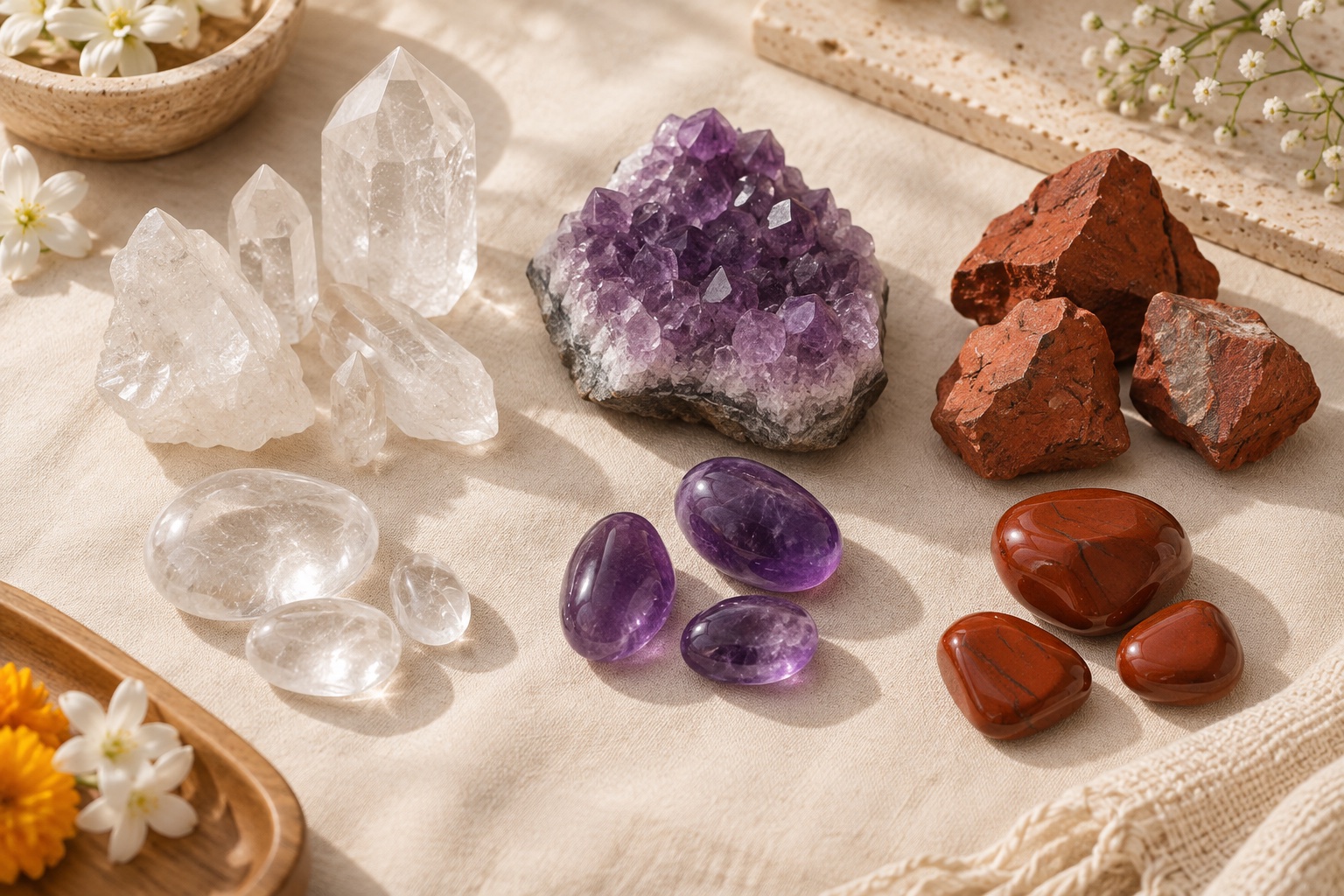
Choosing between raw vs polished crystals mainly comes down to appearance, handling and intended use. Raw stones retain more of their unpolished form, while polished stones have smoother, worked surfaces. Neither finish is automatically better, more genuine or more valuable.
For jewellery, home decor or personal spiritual practices, start with the mineral itself. Then choose a finish that suits how you will wear, carry or display it.
Raw vs Polished Crystals at a Glance
What Are Raw Crystals?
Raw crystals are unpolished stones. However, “raw” does not necessarily mean untouched: a specimen may have been mined, cleaned, broken or cut before sale.
Raw clear quartz may show recognisable crystal faces or irregular broken surfaces. An amethyst raw stone might be a single rough piece rather than a pointed formation. Ask what shaping or treatment a piece has received.
What Are Polished and Tumbled Crystals?
Polishing smooths a stone’s surface, often bringing out its colour, pattern and shine. It can follow cutting or carving.
Tumbling is one finishing method that usually produces rounded, smooth stones. Tumbled stones are a type of polished stone, but polished points, cabochons and spheres are not necessarily tumbled. A cabochon is a shaped stone, commonly with a domed top, used in jewellery.
Raw vs Polished Crystals: Comparison Table
| Feature | Raw crystals | Polished crystals |
|---|---|---|
| Appearance | Natural faces, rough breaks or irregular forms | Smooth surfaces; rounded, carved or geometric shapes |
| Texture | Uneven, grainy, grooved or sometimes naturally smooth | Usually smooth, with a glossy or softer sheen |
| Handling | May have sharp edges or fragile projections | Often comfortable to hold, but can still chip |
| Care | Crevices may trap dust; delicate features need care | Easier to wipe, but not automatically water-safe |
| Typical uses | Collecting, display and securely set jewellery | Pocket stones, jewellery, carvings and decor |
| Price factors | Formation, condition, size, rarity and treatments | Material quality, size, treatments and workmanship |
Appearance, Texture and Handling
Raw pieces are not always pointed crystal formations. Some are compact chunks; others have delicate tips or uneven edges. Check the underside and edges before handling.
Polished stones usually feel smoother, but polishing does not make them unbreakable. Thin edges, pointed carvings and existing fractures can still chip.
Typical Uses, Care and Price Factors
Raw specimens often suit display and collecting, while smooth stones are convenient for jewellery and carrying. Both finishes can work for either purpose with suitable design and handling.
Care depends on mineral identity, not finish alone. Price also reflects size, quality, rarity, treatments and craftsmanship—not simply whether a stone is rough or shiny.
Raw and Polished Red Jasper: A Practical Example
Raw red jasper and polished red jasper show how finishing changes presentation. A rough piece may look muted or uneven, while polishing can make its colour and patterns easier to see.
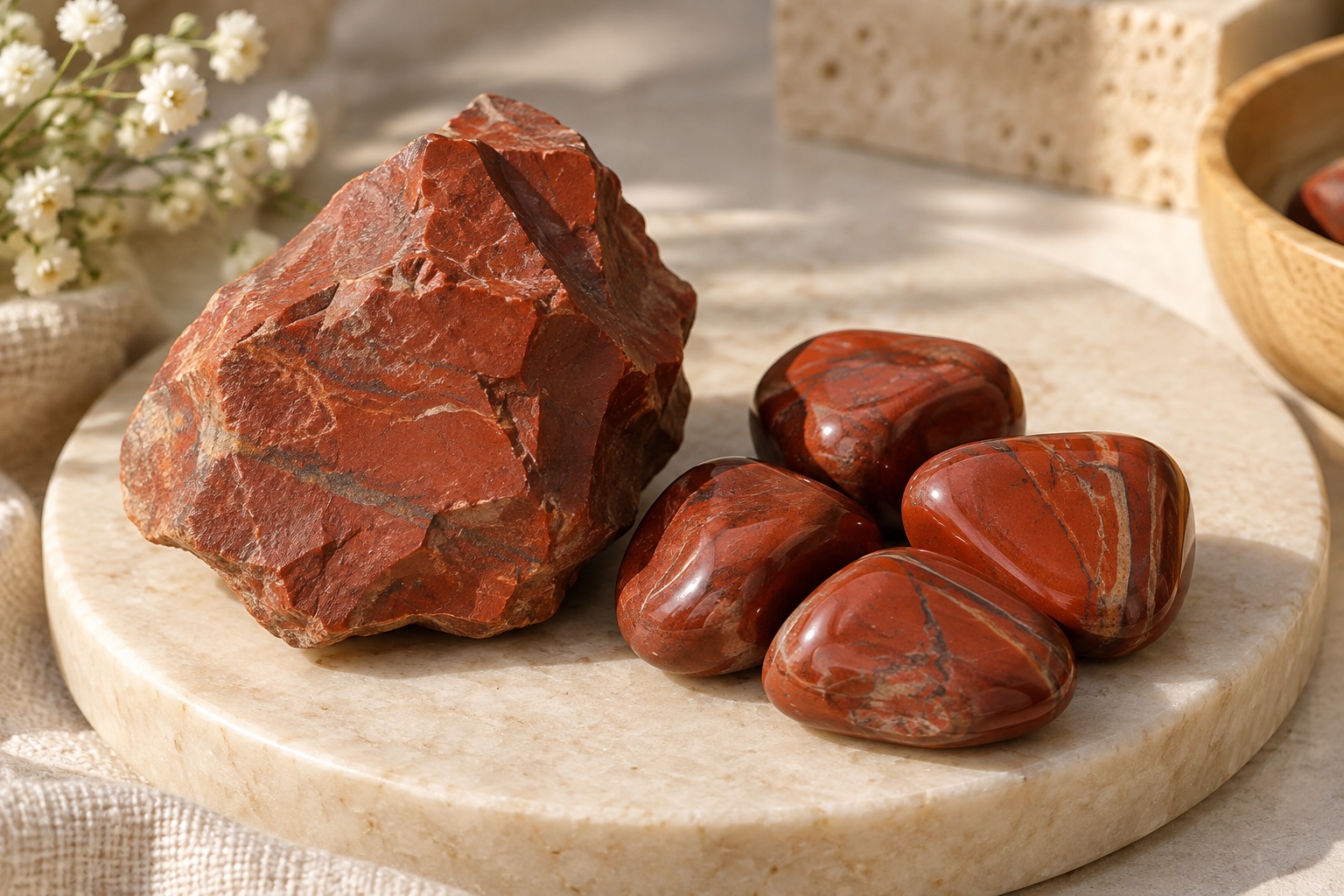
Red jasper, from rough texture to a smooth finish.
For the same starting material, polishing changes the surface and shape without turning it into a different mineral material. Added dyes or coatings are separate treatments that sellers should disclose.
Choosing Red Jasper for Carrying or Display
Choose polished red jasper if you prefer a smooth pocket stone. Raw red jasper may suit a rugged display or a collection focused on unpolished materials.
Neither is inherently higher quality. Compare condition, dimensions and appearance alongside your intended use.
Are Polished Crystals Still Natural and Genuine?
Yes—polishing alone does not make a stone synthetic or fake. A naturally formed stone can be cut and polished while remaining natural material.
Keep four ideas separate: mineral identity, natural or laboratory-created origin, surface finishing, and treatments such as dyes, coatings or filling. A smooth finish proves none of these; neither does a rough appearance.
What to Ask Before Buying
When shopping online in India, ask the seller:
- What is the mineral, and is it natural or laboratory-created?
- Has it been dyed, coated, filled, glued or repaired?
- What are its dimensions and weight?
- Do the photos show the actual piece or a representative sample?
- Are there chips or fractures, and what care is recommended?
Are Raw Crystals More Powerful Than Polished Crystals?
Neither finish has scientifically established superior healing power. Claims that raw stones have “stronger energy” belong to spiritual belief systems, not demonstrated properties.
Crystal traditions may associate particular stones with calm, grounding or protection. These meanings can be personally significant, but they should not be presented as proven effects or medical benefits.
Choosing a Finish for Personal Spiritual Practices
Some people prefer raw textures for their connection with natural forms. Others favour smooth stones because they feel comfortable to hold.
A raw amethyst cluster can serve as a symbolic meditation-space display. Choose it for its meaning and appearance, rather than an expectation of stronger effects.
Which Crystal Finish Should You Choose?
Jewellery and Pocket Stones
Smooth stones and cabochons are often comfortable against skin and less likely to catch on clothing. For daily carrying, choose a manageable size without sharp edges.
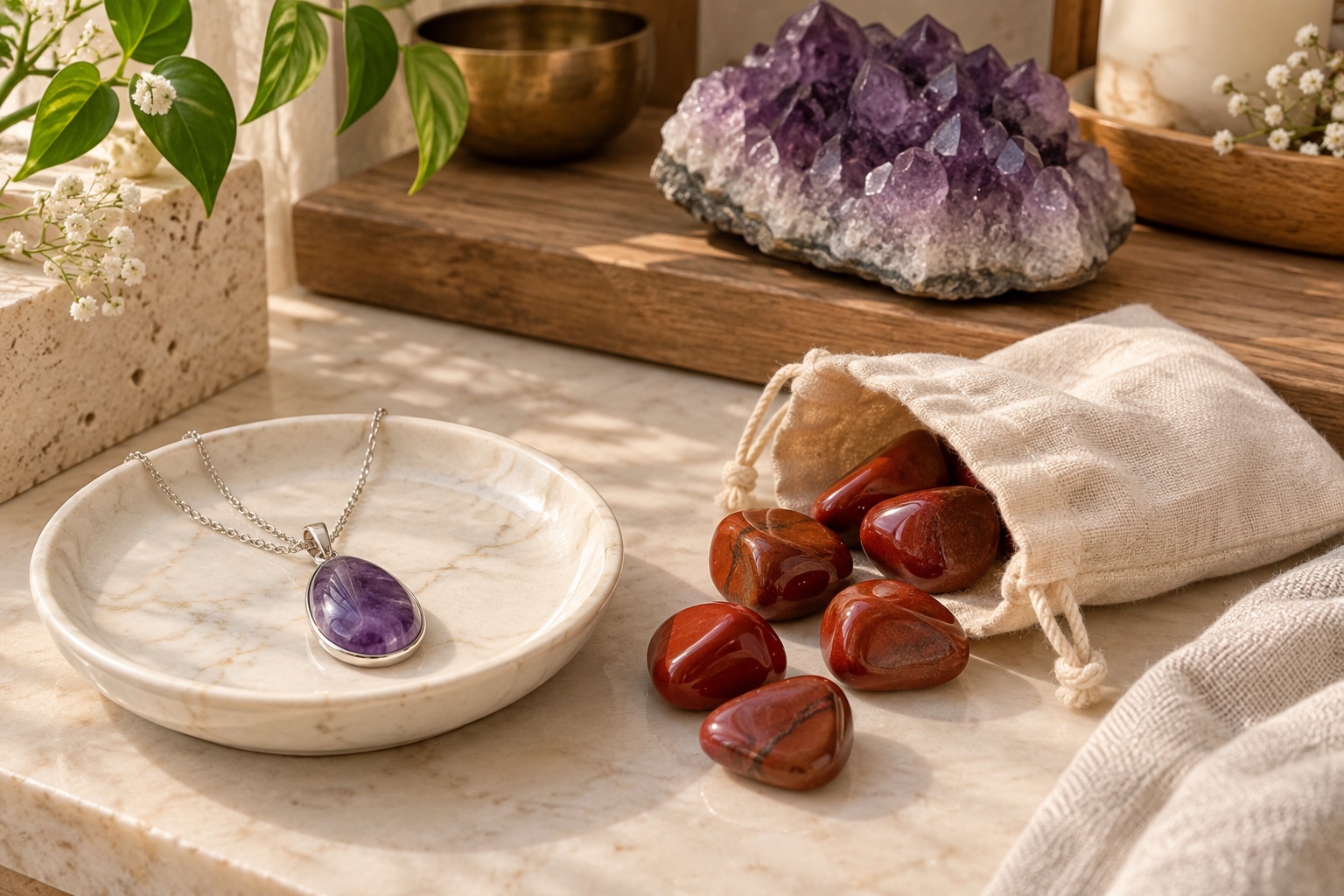
Match the finish to how you will use your crystal.
Raw jewellery needs secure settings and attention to snagging. Mineral durability matters regardless of finish, especially for rings and bracelets exposed to knocks.
Home Decor and Collecting
Raw clear quartz or a raw amethyst cluster offers sculptural detail. Polished spheres, freeforms and carvings provide a more shaped, consistent look.
Check dimensions, base stability and ease of dusting. Use suitable stands and keep small stones or sharp specimens beyond children’s and pets’ reach.
Budget and Value
Raw crystals are not always cheaper. An exceptional natural formation may cost more than a common polished piece, while detailed polishing can add substantial labour.
Compare similar minerals, sizes and conditions. Ask what a seller’s quality grade means rather than assuming labels are consistent across shops.
How to Clean and Care for Raw vs Polished Crystals
Identify the mineral before cleaning. Fractures, coatings, repairs and jewellery settings can change what is safe. Raw crevices collect dust, while a polished surface does not make a stone damage-proof.
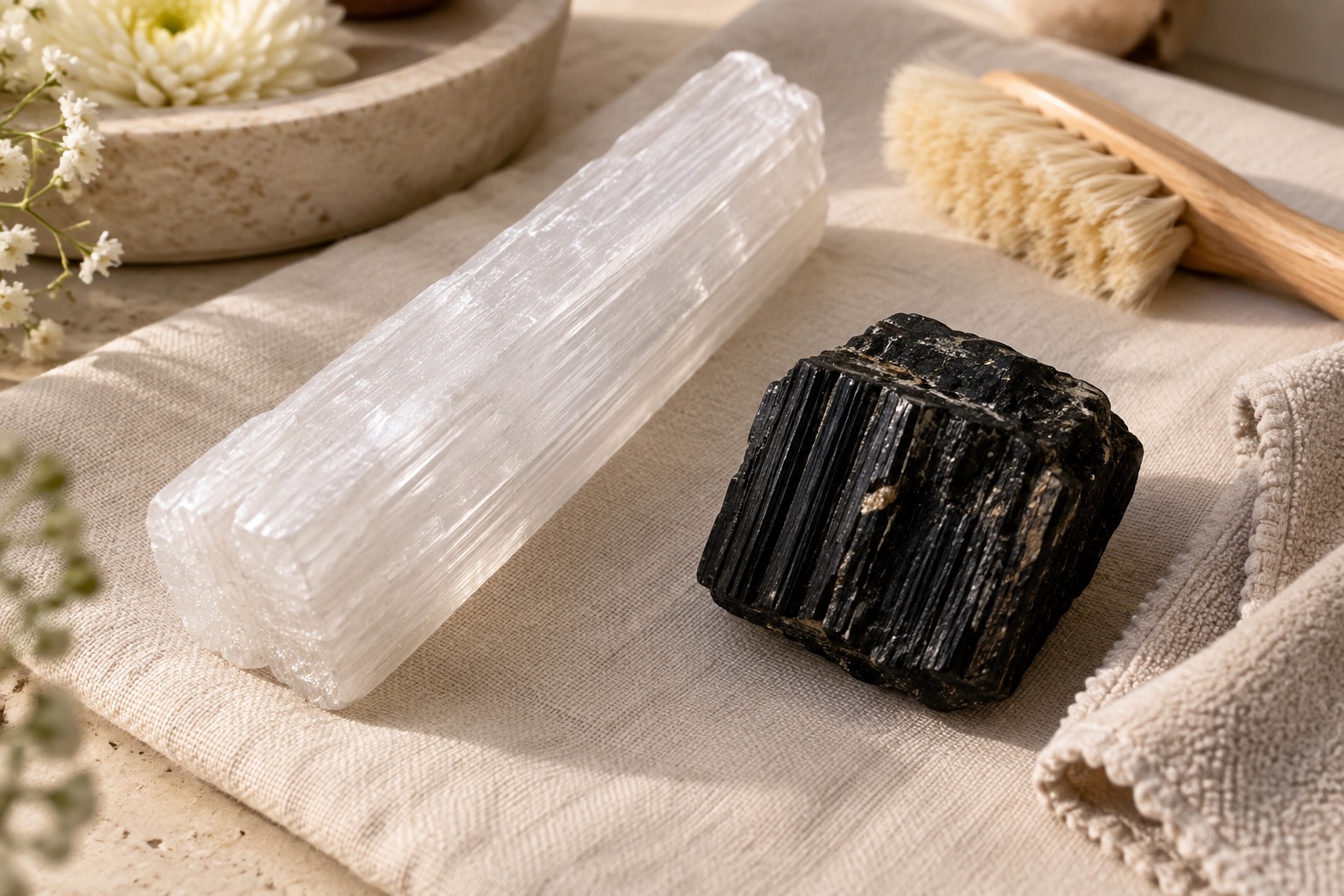
Choose care methods for the mineral, not just its finish.
Clear Quartz, Amethyst and Red Jasper
For sound, untreated, unmounted pieces, brief cleaning with lukewarm water and a little mild soap is generally suitable. Rinse briefly, dry gently and avoid sudden temperature changes. Amethyst may fade with prolonged strong light, so avoid long-term sunny-window display. [Source needed]
For fractured, repaired, coated or mounted pieces, ask for specific care instructions before using water.
Black Tourmaline Raw Stone
Start with gentle dry dusting using a soft brush. A black tourmaline raw stone may have grooves and fragile edges; avoid forceful scrubbing or soaking fractured specimens. Support the piece while cleaning rather than gripping delicate projections. [Source needed]
Raw Selenite
Use a soft, dry cloth or very soft brush on raw selenite. It is soft and sensitive to water, so avoid soaking and store it separately to limit scratches. Polishing does not remove these vulnerabilities. [Source needed]
Storage and Display in Indian Homes
Use padded compartments to prevent stones knocking together, and stable shelves away from harsh window light.
During the monsoon, check packaging for dampness and metal settings for moisture. Let cleaned pieces dry fully before storage, while following each mineral’s care requirements.
FAQs About Raw vs Polished Crystals
Are Tumbled Stones the Same as Polished Crystals?
Tumbled stones are a type of polished stone. Not every polished crystal is tumbled; other shapes may be individually cut and polished.
Does Polishing Make a Crystal Fake?
No. Polishing changes the surface. Authenticity depends on the material, its origin and accurate disclosure of treatments.
Are Raw Crystals Always Cheaper or More Powerful?
No. Price depends on material quality, condition and workmanship. Superior healing power has not been scientifically established for either finish.
Can I Clean Every Crystal with Water or Leave It in Sunlight?
No. Follow mineral-specific guidance: avoid soaking raw selenite, and protect amethyst from prolonged strong light. [Source needed]
Which Finish Is Better for Everyday Carrying?
A smooth, rounded stone is usually more comfortable. Check for chips, choose a suitable size and carry it separately from keys.
Can Polished Crystals Still Break?
Yes. They can chip or break if dropped or knocked. Smoothness does not remove fractures or make delicate shapes stronger.
Conclusion: Choose the Crystal Finish That Fits Your Needs
The raw vs polished crystals choice is about fit, not a universal winner. Raw stones offer unpolished character; polished stones offer smooth handling and shaped designs.
Prioritise mineral identity, safe handling, clear seller information and personal preference. Explore Crafting Crystals with these checks in mind to find a piece that suits your space, style or personal practice.
Find a natural crystal that feels right for you.
Shop the collection